
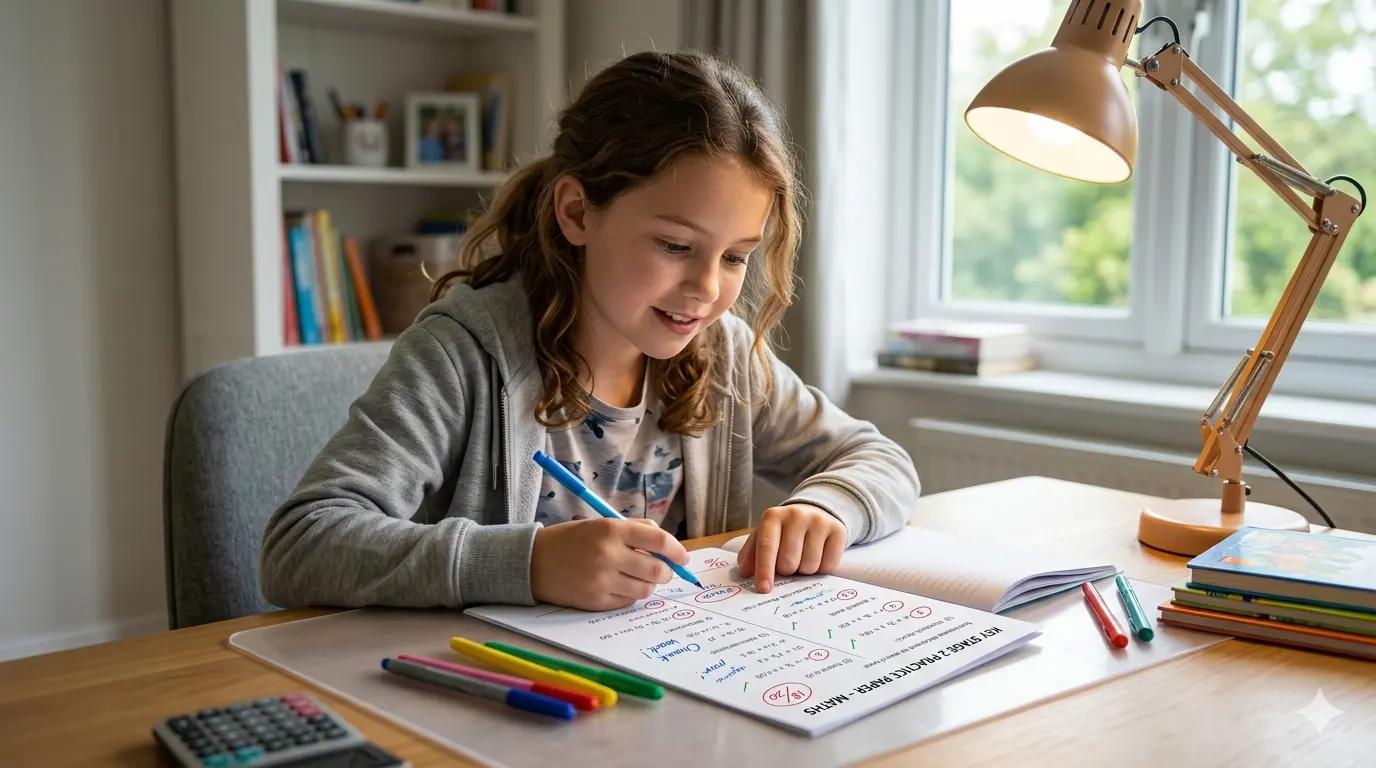
Short on time? Most children do practice papers, check the score, and move on. The ones who improve fastest do something different. They go back to every wrong answer and figure out exactly why they got it wrong. This single habit, reviewing mistakes properly, is worth more than any number of extra papers. This guide shows you how to build it into your child's preparation.
The Problem With Just Doing More Papers
There is a widespread belief in 11+ preparation that volume equals progress. Do enough papers and the score will go up. It sounds logical, but it is not how learning actually works.
If your child gets question 14 wrong on paper one, then gets a very similar question wrong on paper five, and then again on paper nine, they have not practised. They have repeated the same mistake three times. Without stopping to understand what went wrong, they are simply reinforcing the error.
Think of it like driving. If you keep taking the same wrong turn at the same roundabout, driving around that roundabout more often will not fix the problem. You need to stop, look at the map, and understand why you keep going the wrong way.
The Three Types of Mistakes
Not all wrong answers are the same. Teaching your child to categorise their mistakes is the first step to fixing them. Every wrong answer falls into one of three categories.
Type 1: Silly Mistakes
These are the ones where your child knows how to do the question but got it wrong anyway. They misread the question, copied a number incorrectly, forgot to check their units, or rushed and picked the wrong multiple choice option.
Silly mistakes are frustrating because the knowledge is there. The fix is not more teaching. It is better habits: reading the question twice, underlining key words, checking answers, and slowing down just enough to be accurate.
Type 2: Method Mistakes
These happen when your child knows the general topic but uses the wrong approach or misses a step. For example, they might understand fractions but forget to find a common denominator before adding. Or they might know what a synonym is but confuse it with an antonym under pressure.
Method mistakes need targeted practice on the specific skill that is going wrong. Not more general papers, but focused work on the exact step where the process breaks down.
Type 3: Knowledge Gaps
These are questions your child simply did not know how to answer. They have not learned that topic yet, or the explanation they received did not stick. No amount of practice will fix a knowledge gap. The topic needs to be taught again, possibly in a different way.
| Mistake Type | Example | Fix |
|---|---|---|
| Silly Mistake | Wrote 36 instead of 63 when reversing digits | Build checking habits. Slow down on easy questions. |
| Method Mistake | Added fractions without finding common denominator first | Practise that specific method until it becomes automatic. |
| Knowledge Gap | Did not know what an isosceles triangle is | Teach the concept from scratch. Then practise. |
Once your child can look at a wrong answer and say "that was a silly mistake" or "I did not know how to do that," they have already taken a huge step forward. They are thinking about their own thinking, which is exactly the skill that turns practice into progress.
How to Build an Error Journal
An error journal is simply a notebook where your child records their mistakes and what they learned from them. It does not need to be complicated. A lined exercise book works perfectly.
What to Record
For each wrong answer, write down:
- The date and which paper or exercise the question came from
- The question (or a brief summary of it)
- What they answered
- What the correct answer was
- Which type of mistake it was (silly, method, or knowledge gap)
- What they need to remember next time
An Example Entry
Here is what a real error journal entry might look like:
Date: 15 July
Paper: GL Assessment Practice Paper 3, Question 22
Topic: Percentages
My answer: 25
Correct answer: 75
Mistake type: Method mistake
What happened: I found 25% of 300 instead of finding what percentage 75 is of 300. I did the wrong calculation because I misread what the question was asking.
What to remember: Read percentage questions twice. Underline what the question is actually asking me to find.
That entry takes two minutes to write. But the act of writing it forces your child to engage with the error in a way that simply seeing a red cross next to the answer never does.
When to Review: The Spacing Effect
There is a well established finding in learning science called the spacing effect. Information sticks better when you revisit it at increasing intervals rather than cramming it all at once.
For error journal entries, a simple schedule works well:
- Same day: Write the entry and understand the mistake
- Next day: Glance through yesterday's entries. Can your child explain what went wrong without looking at the answer?
- One week later: Try a similar question on the same topic. Has the mistake been fixed?
- Two to three weeks later: Revisit again. If they get it right, the fix has stuck. If not, it needs more work.
You do not need to be rigid about this schedule. The principle is simple: come back to mistakes more than once, with gaps in between. That is how the brain moves information from short term to long term memory.
Making It Work With Your Child
Let us be honest. Most ten year olds are not going to leap at the chance to keep a detailed error journal. You need to make this as painless as possible.
Keep It Short
Five minutes after each practice session is enough. Do not turn the review into something longer than the practice itself. Pick the three or four most important mistakes, not every single one.
Do It Together at First
Sit with your child for the first few weeks and go through the review together. Model the thinking out loud: "Okay, so this one was wrong. Let us look at what happened. You knew how to do percentages but you found the wrong thing. So that is a method mistake. What could you do differently next time?"
Once your child gets the hang of it, they can start doing reviews independently, but check in regularly to make sure the habit is sticking.
Celebrate the Process, Not Just the Score
This is important. If you only praise high scores on practice papers, your child will dread getting things wrong. And if they dread getting things wrong, they will not engage honestly with their mistakes.
Instead, praise the review process itself: "I can see you really thought about why that question tripped you up. That is exactly how you get better." When your child sees that you value understanding over perfection, they stop hiding from their errors and start learning from them.
Common Patterns to Watch For
After a few weeks of keeping an error journal, patterns will start to emerge. These patterns are gold because they tell you exactly where to focus your child's limited preparation time.
- Same topic keeps appearing: If fractions come up in the error journal week after week, that topic needs dedicated teaching time, not just more practice.
- Lots of silly mistakes: This usually means your child is rushing. Work on pacing and build in a checking step at the end of each section.
- Mistakes cluster at the end of papers: This suggests fatigue or time pressure. Practise stamina with longer sessions, or work on speed so there is less rush at the end.
- One subject dominates: If almost all errors are in maths but English is clean, you know where the time should go.
- Mistakes on easy questions: Sometimes children get hard questions right but trip on straightforward ones because they switch off when a question looks simple. This is a concentration issue, not a knowledge issue.
Using PrepGlide's Practice Data
If your child uses PrepGlide for practice, you already have a head start. The platform tracks which questions your child gets wrong and which topics need more work. You can use this data to focus your error journal on the areas the system has flagged, rather than trying to spot patterns yourself.
The adaptive practice engine automatically serves more questions on weaker topics, which means your child is already doing a form of targeted review every time they practise. The error journal adds the reflection layer on top: not just doing the questions again, but understanding why they went wrong in the first place.
The Growth Mindset Connection
You may have heard the term growth mindset, coined by psychologist Carol Dweck. The core idea is that children who believe their abilities can improve with effort tend to perform better than those who believe ability is fixed.
An error journal is one of the most practical ways to build a growth mindset. Every entry is evidence that mistakes are not failures. They are information. They are data points that tell you exactly what to work on next. Over time, your child starts to see a wrong answer not as something to feel bad about, but as something useful.
This shift in attitude matters far beyond the 11+. Children who learn to review their mistakes constructively carry that skill into secondary school, into GCSEs, into university, and into adult life. You are not just preparing your child for an exam. You are teaching them how to learn.
What to Do When Your Child Gets Upset About Mistakes
Some children take every wrong answer personally. They cry, they shut down, they say they are stupid. If this is your child, the error journal needs to be introduced very gently.
Start by normalising mistakes. Share your own. "I made a mistake at work today. I sent an email to the wrong person. I felt embarrassed for a minute, then I fixed it and moved on." Children need to see that the adults in their life make errors too, and that it is not the end of the world.
When reviewing a practice paper with a sensitive child, lead with what went well before looking at mistakes. "You got 35 out of 40 right. That is really strong. Let us look at the five you missed and see what we can learn." The word "learn" is doing heavy lifting in that sentence. It frames the review as an opportunity, not a punishment.
If your child is consistently distressed by wrong answers, consider reducing the number you review to just one or two per session. It is better to review two mistakes calmly than to attempt ten while your child is in tears.
A Quick Review Routine
Here is a simple five minute routine you can use after every practice session:
- Mark the paper together (or let your child self-mark with the answer sheet)
- Count the wrong answers. No drama. Just a number.
- Pick the three most useful mistakes (prioritise method mistakes and knowledge gaps over silly ones)
- For each one, ask: "What happened here?" Let your child explain before you jump in.
- Write a one line note in the error journal for each
- Move on. Do something fun. The review is done.
That is it. Five minutes, consistently applied, will do more for your child's score than an extra hour of practice papers.
Want to make the most of practice papers? → Using Mock Exams Without Causing Burnout
Looking for key maths topics to focus on? → Essential Maths Topics for the 11+
Try our adaptive practice tools to automatically target your child's weak areas.