Short on time? Start full mock exams no earlier than late spring of Year 5. Do them fortnightly at most. Spend twice as long reviewing the paper as your child spent sitting it. Stop grading every single one and start treating them as a learning tool, not a scorecard.
Why Mock Exams Matter (When Used Well)
A well timed mock exam does something that daily practice sheets cannot. It puts your child in exam conditions: a timed paper, a quiet room, no help from you, and the mental stamina of working through a full paper from start to finish. That experience builds familiarity with the real thing, and familiarity is one of the most reliable ways to reduce exam day nerves.
But mock exams also carry risks. Done too often, they become a source of weekly anxiety. Done without proper review, they teach your child nothing except how to feel bad about a score. Done too early, before your child has covered the core material, they create a false sense of failure that damages confidence.
The goal is to find the sweet spot where mocks build confidence and reveal useful information without becoming the thing your child dreads most about their week.
When to Start: Not as Early as You Think
Many parents begin full mock papers in Year 4 or the autumn of Year 5. For most children, this is too early. If your child has not yet covered all the topics that appear in the exam, a full mock will simply expose them to questions they have not learned how to answer. That is not useful assessment. It is just discouraging.
A more effective approach follows three stages:
| Stage | When | What to Do |
|---|---|---|
| Topic practice | Autumn and Spring, Year 5 | Short, focused exercises on individual topics (15 to 20 minutes). No full papers yet. |
| Section tests | Late Spring, Year 5 | Half papers or single subject papers under timed conditions. Introduce the idea of working to a clock. |
| Full mocks | Summer, Year 5 onwards | Complete papers under proper exam conditions. Review thoroughly. |
By the time your child sits their first full mock, they should have covered all the major topics at least once. This means the mock is testing application and exam technique, not whether they have been taught the material.
How Often: Less Is More
Here is where most families go wrong. The temptation is to do a mock every weekend, sometimes even more often. Parents understandably want data. They want to see the score going up. They want to feel like something is happening.
But a child who sits a mock every Saturday quickly starts to associate weekends with stress. The scores become the only thing that matters, and each one carries emotional weight. A dip in score feels like a disaster. A good score creates pressure to maintain it. The whole process becomes about numbers rather than learning.
A better schedule looks like this:
| Period | Frequency | Why |
|---|---|---|
| June to July, Year 5 | Once every two to three weeks | Introduce the format gradually. Focus on building stamina and timing. |
| Summer holidays | Once a week at most | Still leave several days between mocks for review and rest. |
| Final two weeks before the exam | One, then stop | Taper off. The last week should be light revision and rest, not intensive testing. |
In total, most children benefit from doing somewhere between 8 and 14 full mock papers before exam day. That is plenty. More than that and you start running out of quality papers and your child starts running out of patience.
Setting Up Proper Exam Conditions
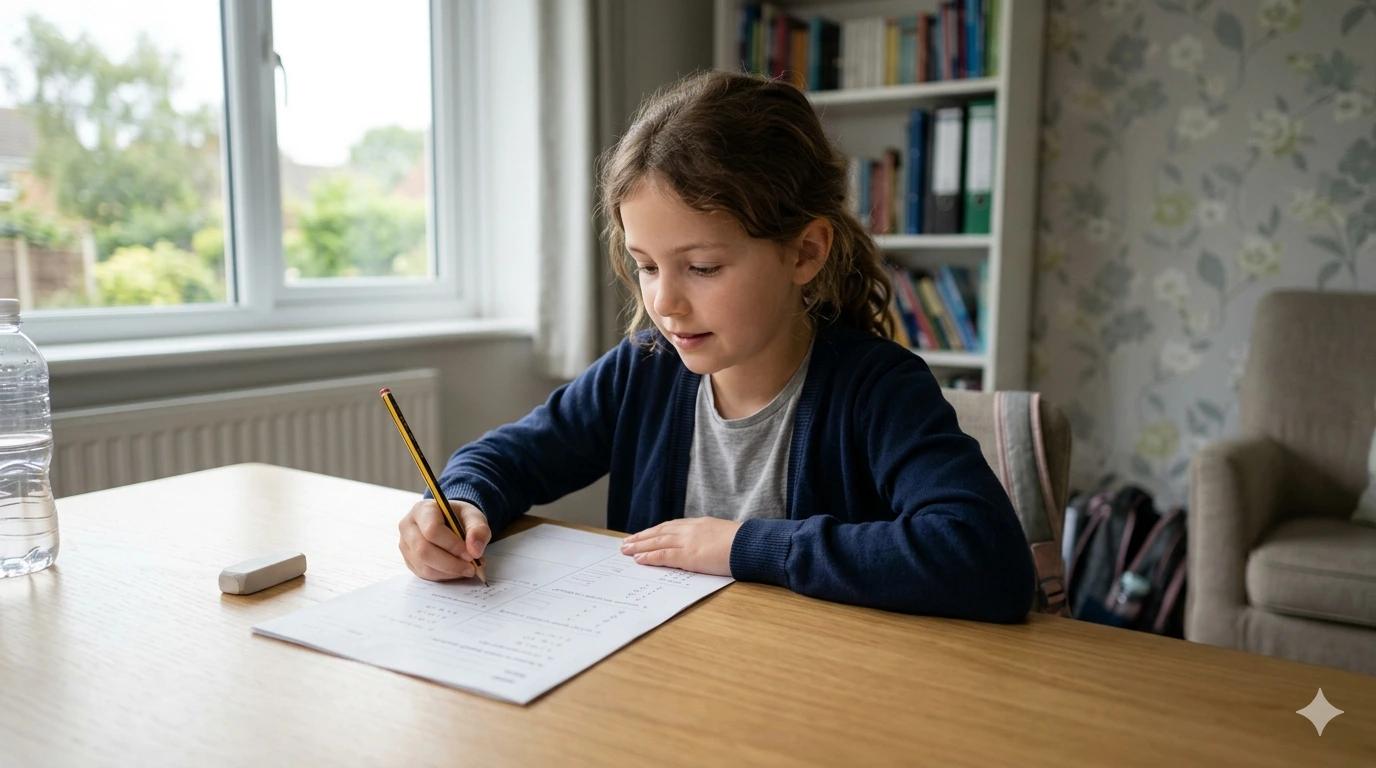
If you are going to use mock time, make it count. A mock done at the kitchen table with the television on in the background and a parent hovering nearby is not a mock. It is just a practice paper with a timer.
Proper exam conditions mean:
- A quiet room with the door closed
- All distractions removed (phones, tablets, toys, pets)
- A desk or table with nothing on it except pencils, an eraser, and the paper
- A visible clock or timer (not a phone)
- You leaving the room. Seriously. Your child needs to experience working without you there.
- No help, no hints, no answering questions about what a word means
The first time you do this, your child may find it strange or uncomfortable. That is the point. You want them to experience that slight discomfort now, in a safe environment, so it feels familiar on the actual day.
What About External Mock Exams?
Several companies run mock exam days in school halls with other children, designed to simulate the real test environment. These can be very useful, particularly for children who have been doing all their practice at home. Sitting in a room full of strangers, with an unfamiliar invigilator, adds a layer of realism that home mocks cannot replicate.
One or two of these external mocks is usually enough. They cost between £30 and £80 each and the quality varies. Ask other parents for recommendations specific to your area and exam type (GL, CEM, or school-set).
The Review: Where the Real Learning Happens
This is the part that most families rush through, and it is the part that matters most. The mock paper itself is just data collection. The review is where your child actually learns something.
Wait Before Reviewing
Do not review the paper immediately after your child finishes. They are tired, possibly frustrated, and not in the right frame of mind to learn from their mistakes. Leave it at least a few hours, ideally until the next day.
The Three-Category Method
When you sit down to review, go through every wrong answer and sort it into one of three categories:
| Category | What It Means | What to Do About It |
|---|---|---|
| Careless errors | Your child knows how to do this but made a silly mistake (misread the question, added instead of subtracted, filled in the wrong bubble) | Practice checking technique. These reduce with familiarity, not with more teaching. |
| Knowledge gaps | Your child does not know the method, the vocabulary word, or the concept being tested | Go back and teach or reteach this specific topic. Add it to the study plan. |
| Timing issues | Your child ran out of time and either guessed or left questions blank | Work on pacing. Practice moving on from difficult questions and coming back to them. |
This method is powerful because it tells you exactly what to focus on next. If most errors are careless, you do not need more teaching. If most are knowledge gaps, you need to adjust your study plan. If most are timing, you need to practise working faster on easier questions to buy time for harder ones.
What to Do With the Score
Here is an unpopular opinion: stop obsessing over mock scores. A mock score is useful information, but it is not a prediction of your child's exam result. Mock papers vary in difficulty. Your child's performance varies from day to day. The conditions at home are different from the conditions in the exam hall.
Use scores to spot trends over time rather than reacting to each individual number. If the overall direction across four or five mocks is upward, your child is progressing. If it is flat or declining, something needs to change in your approach. A single low score after a bad night's sleep tells you nothing about your child's ability.
Should You Tell Your Child Their Score?
This depends on your child's temperament. Some children are motivated by seeing their score improve and enjoy tracking their progress. Others become anxious or discouraged when they see a number, especially if it feels lower than expected.
A middle ground that works for many families: share general feedback ("you improved on the maths section and the timing was much better") without sharing the exact percentage or standardised score. Focus on specific improvements rather than the headline number.
Signs You Are Overdoing It
Watch for these warning signs that mock exams have tipped from helpful to harmful:
- Your child cries, argues, or refuses on mock day
- They ask repeatedly during the week whether a mock is coming up
- Sleep is disrupted on the night before a mock
- They seem to have given up and rush through the paper without trying
- You find yourself more anxious about the mock score than they are
- The review sessions have turned into arguments
- Your child's scores are declining despite increased practice
If you recognise three or more of these, take a break from mocks for two to three weeks. Replace the mock time with lighter, more enjoyable practice or just a normal weekend. Coming back after a break almost always produces better results than pushing through the resistance.
Common Mock Exam Mistakes Parents Make
Using the Same Paper Twice
If your child has seen the questions before, even months ago, the result is meaningless. They may remember answers without understanding the method. Keep a list of which papers you have used and do not repeat them.
Helping During the Mock
If you explain a question, point out an error, or even just react visibly when they write something wrong, you are not running a mock. You are doing guided practice, which has its own value but is a different thing entirely.
Marking and Reviewing Without Your Child
It is tempting to mark the paper yourself and just tell your child what they got wrong. But the review is most effective when your child is involved. Let them mark their own paper (with the answer sheet) and identify their own mistakes. This builds self-awareness and ownership of the learning process.
Comparing With Other Children
"Emma's daughter got 85 percent on the same paper." This information is useless and potentially damaging. Every child is on a different trajectory. The only comparison that matters is your child's current paper against their previous ones.
A Sensible Mock Exam Calendar
Here is a realistic schedule for a child taking the September 11+ exam:
| Month | Activity | Total Mocks to Date |
|---|---|---|
| May (Year 5) | First full mock at home, low pressure | 1 |
| June | Second mock, focus on timing | 2 |
| July | Third mock, possibly one external mock day | 3 to 4 |
| August (weeks 1 and 2) | Weekly mocks with thorough review between each | 5 to 6 |
| August (weeks 3 and 4) | Weekly mocks, one more external mock if available | 7 to 9 |
| Early September | One final mock, then stop | 8 to 10 |
| Final week before exam | No mocks. Light revision, rest, normal activities | Done |
The Week Before the Exam: Put the Mocks Away
The final week should not include any timed papers. Your child's preparation is essentially complete by this point, and a bad score days before the real exam can seriously dent their confidence. Use this time for light revision of topics they feel shaky on, some gentle reading, and plenty of normal life. Rest, play, early bedtimes, and familiar routines will do more for their performance than one last cramming session.
Planning the full preparation timeline? → The Ultimate 11+ Preparation Timeline
Want to understand how scores translate to results? → 11+ Scoring Demystified
Try our adaptive practice tools for targeted daily preparation between mocks.