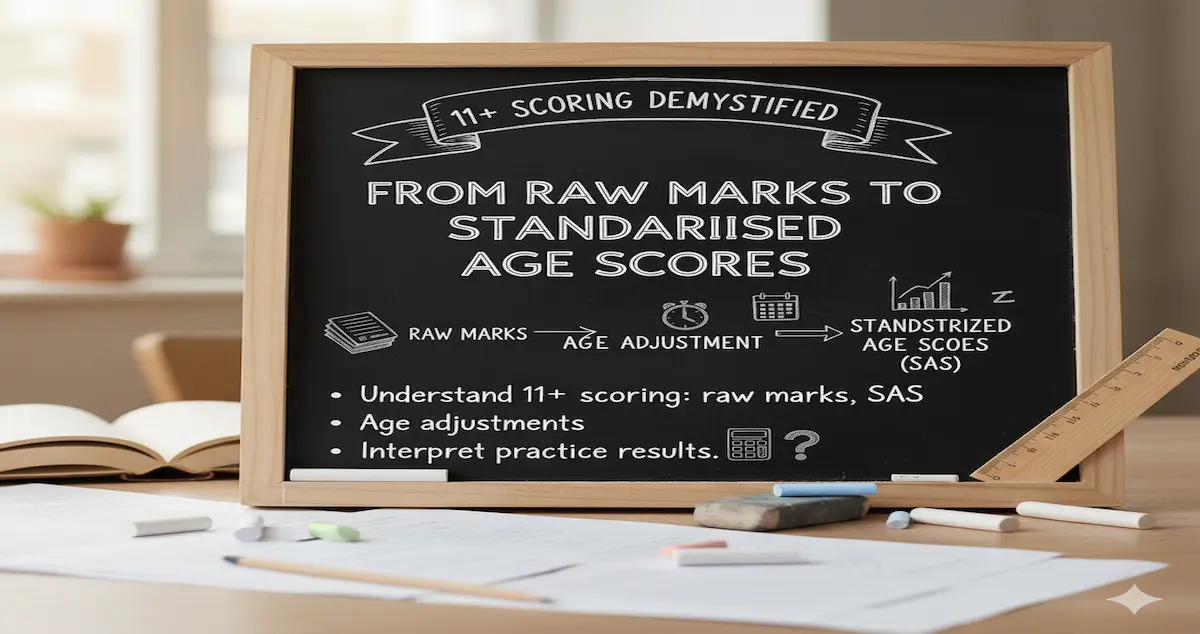
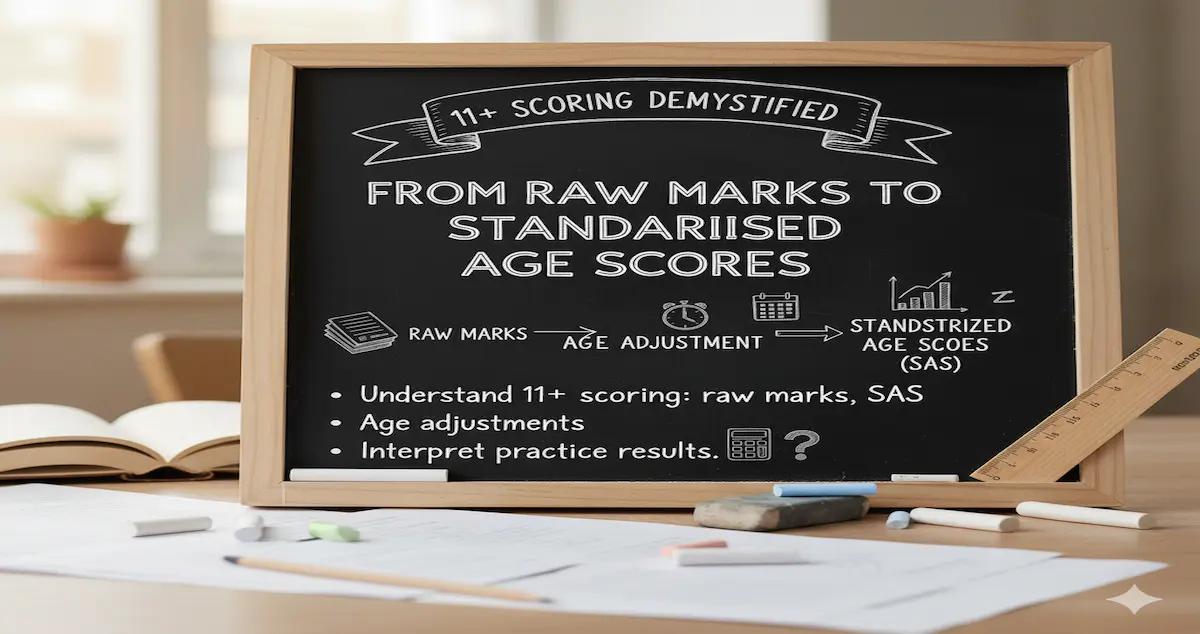
Ever wondered if a 72% practice score means your child will qualify for grammar school? The answer is: not always! Let's break down how the 11+ is scored and why the Standardised Age Score (SAS) matters.
Why Scoring Feels Confusing
Most practice papers give a raw percentage. But the official 11+ uses a system that levels the playing field, adjusting for age and test difficulty. This means a raw mark is just the start of the story.
Raw Score vs Standardised Age Score (SAS)
| Score Type | What It Means | Used For Admissions? |
|---|---|---|
| Raw Score | Number correct | No |
| SAS | Adjusted for age & paper | Yes |
- Raw Score: Simple count of correct answers.
- SAS: Your child's raw score is adjusted for two things:
- Age: Younger children (e.g., summer-born) get a slight positive adjustment.
- Paper Difficulty: Harder papers are normalised so scores are comparable across years.
How Is SAS Calculated?
While the exact formula is a secret, here's the principle:
- Scores are analysed by age in months.
- A score of 100 is the average for that age group.
- For example, above 115 might be considered strong; 120+ could be top 10–15%.
- Scores are mapped to a "bell curve"—so a SAS of 130+ is rare.
Why Age Matters
| Child's Birth Month | Adjustment |
|---|---|
| September–December | None |
| January–April | Small boost |
| May–August | Larger boost |
Example:
If two children get identical raw marks, but one is born in August and the other in November, the August-born child's SAS may be slightly higher.
Subject Weighting
Not every region weights subjects the same. Common patterns:
- Kent: Maths and Verbal Reasoning carry extra weight.
- Others: All subjects equal, or English is weighted more.
Always check your local grammar school's admissions info!
Interpreting Practice Test Results
- Practice Paper % ≠ SAS!
- Use practice scores as feedback on topic strengths and speed, not as a prediction of your final outcome.
- Look for upward trends, not isolated highs or lows.
Avoiding False Confidence
- Memorising answers or repeating the same practice paper can inflate scores.
- Mix up papers and track types of errors (timing, carelessness, topic gaps).
When to Start Full Mocks (and How Many)
- Begin full mock tests about 8–10 weeks before the real exam.
- Space them out (not more than one per week).
- Deep review after each: What went wrong and why?
Quick FAQ
Q: What SAS is considered "good"?
A: This varies significantly by consortium. For example, some areas like Slough may qualify students with SAS 110+, while others like Buckinghamshire require 121+. These examples show how much requirements can differ—always check your specific local area's requirements.
Q: Can a summer-born child qualify more easily?
A: Their score is adjusted, but everyone faces the same selection pool and qualifying thresholds.
Q: Does the school see raw marks?
A: No—only SAS and subject breakdowns.
🎯 Want to estimate your child's SAS? Take our free diagnostic and get a projected range based on three short tests.
Need help with GL vs CEM formats? → GL vs CEM: Which Exam Style Fits Your Child?
Ready to plan your preparation? → The Ultimate 11+ Preparation Timeline
Use our score calculator to understand what your child's practice scores mean.